
Broadcast format

Multi-site broadcasts

Connect four sites with four separate set-ups and you get four programs, four delays and nobody in charge. We build one directed broadcast across every location, with one person accountable for all of it.

A multi-site broadcast connects several offices, plants, venues or countries into one live program. Each location either receives the broadcast or contributes to it, and one director brings the contributing sites, presenters and content together into a single feed. The work is in the planning: which sites send and receive, how each one connects, what happens if one drops, and who is responsible on site.

Also known as: Multi-location broadcast · Multi-office livestream · Connected sites broadcast

Service
Multi-Site Broadcast Production
Provided by
First Impact, Mexico-based, backed by Castelein AV
Where
Mexico City, Querétaro and elsewhere in Mexico
For
Global and regional companies communicating across several countries; Manufacturers connecting plants with headquarters
Pricing
Scoped per event; no fixed packages
Examples
ICON, ITP Aero
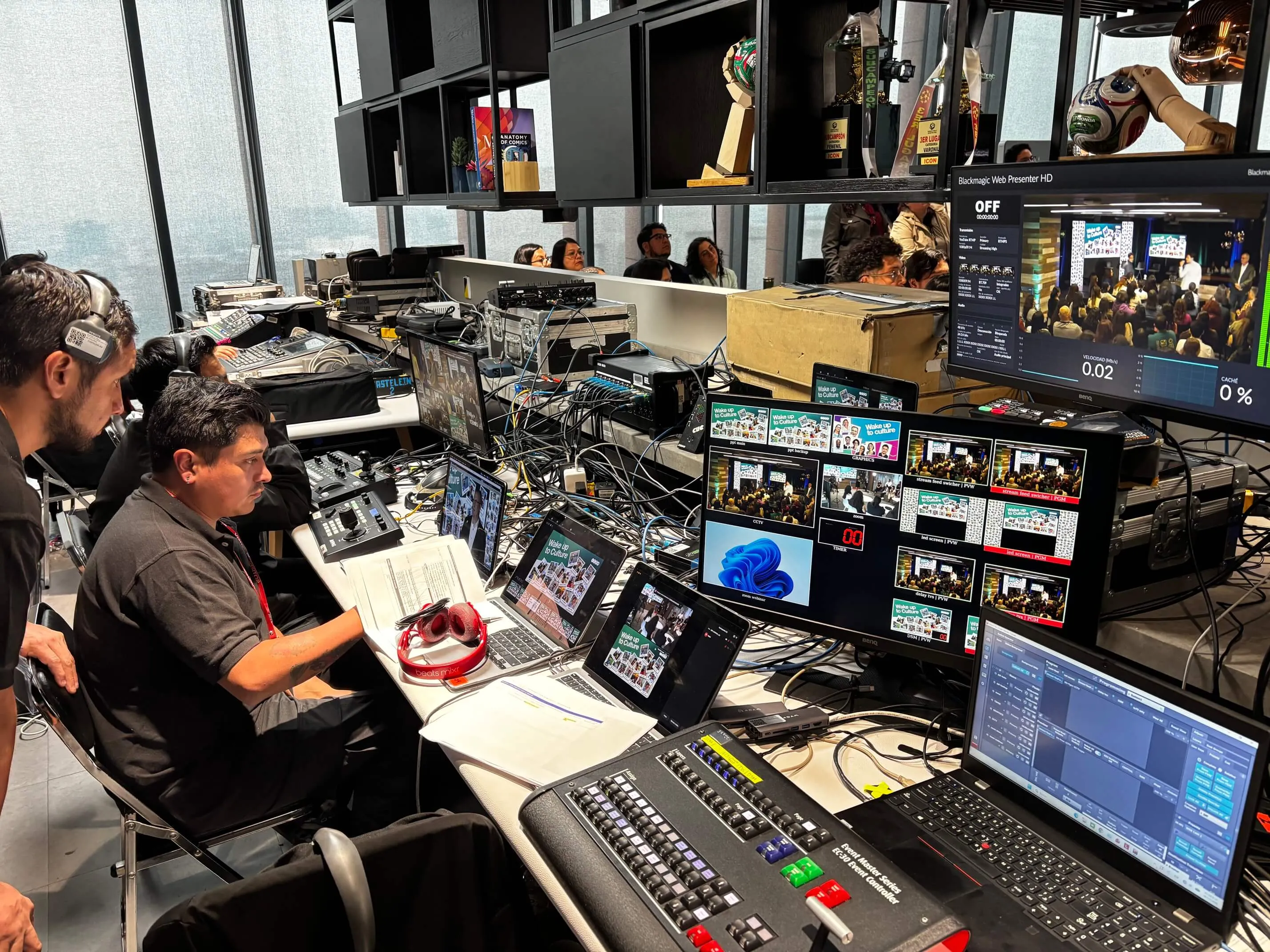
Local control position for the ICON Mexico City hub: video switchers, program monitors and a streaming encoder operated by the crew.

Who it is for

  • Global and regional companies communicating across several countries
  • Manufacturers connecting plants with headquarters
  • Organisations launching in several cities at once
  • International producers who need a Mexico site inside a wider broadcast
  • Agencies coordinating a multi-location event for a client

When it is useful

  • A company-wide broadcast with leadership in one country and teams in others
  • A plant in Mexico contributing live to a global program
  • A launch shown at the same time in several cities
  • A Mexico hub joining a broadcast directed from abroad
  • An event with satellite venues that need to see and hear the main stage

What the scope may include

Every site adds a connection, a contact and a risk. Depending on the program, the scope may include:

Production design across sites

One plan for every location: who sends, who receives, and how each feed reaches the program.

Local production at each site

Cameras, audio and screens at the Mexico sites, or local crews elsewhere directed to the same standard.

Contribution from remote sites

Sites sending video and audio into the program, with return feeds so they can hear and take part.

Shared graphics and run of show

One graphics package and one running order across every location.

Connectivity and redundancy

Connection checks per site and backup links in proportion to the risk.

Integration with an external broadcast team

Your Mexico site built into a workflow designed and directed by another producer.

One point of ownership

A single production lead accountable for the program end to end.

What requires separate confirmation

These depend on local providers, other teams or third parties, so we confirm them per project:

  • Internet at each location, which depends on local providers and lead times
  • Equipment and crew outside Mexico, where they are needed
  • Platform licences and accounts
  • Interpretation between languages
  • Travel and access to each site
  • Editing and versions after the broadcast

How planning and delivery work

  1. Brief and site map

    Every location listed, with what it sends, what it receives and who is in charge there.

  2. Connectivity and site review

    Connection, power and space checked per site, with one contact at each.

  3. Scope and proposal

    A written scope with inclusions, exclusions and the protections that apply.

  4. Connection tests and rehearsal

    Every contributing site connected to the program before the day, then a rehearsal of the hand-offs.

  5. Live broadcast

    One director, monitored sites and local recording throughout.

  6. Recording and deliverables

    The recording and any agreed edits.

What determines the price

A multi-site budget grows with the number of sites that send, not the number that watch:

  • Number of sites and how many contribute
  • Cameras and crew at each contributing site
  • Distances, travel and local crews outside Mexico
  • Connectivity and backup at each site
  • Interpretation and languages
  • Rehearsals and test sessions across sites
  • Recording and post-event deliverables

Share a budget range in your brief and we will propose a scope that fits it, with the trade-offs of each option.

What shapes scope: Production Budget Guide

Organise your requirements with the AI planner

Relevant case studies

Local control position for the ICON Mexico City hub: video switchers, program monitors and a streaming encoder operated by the crew.

ICON · Mexico City

ICON global hybrid event: the Mexico City hub

An international broadcast producer needed a local team to build and run the Mexico City hub of a global hybrid event around its own workflow.

DV4 directed the global broadcast. Castelein AV built and ran the Mexico City hub.
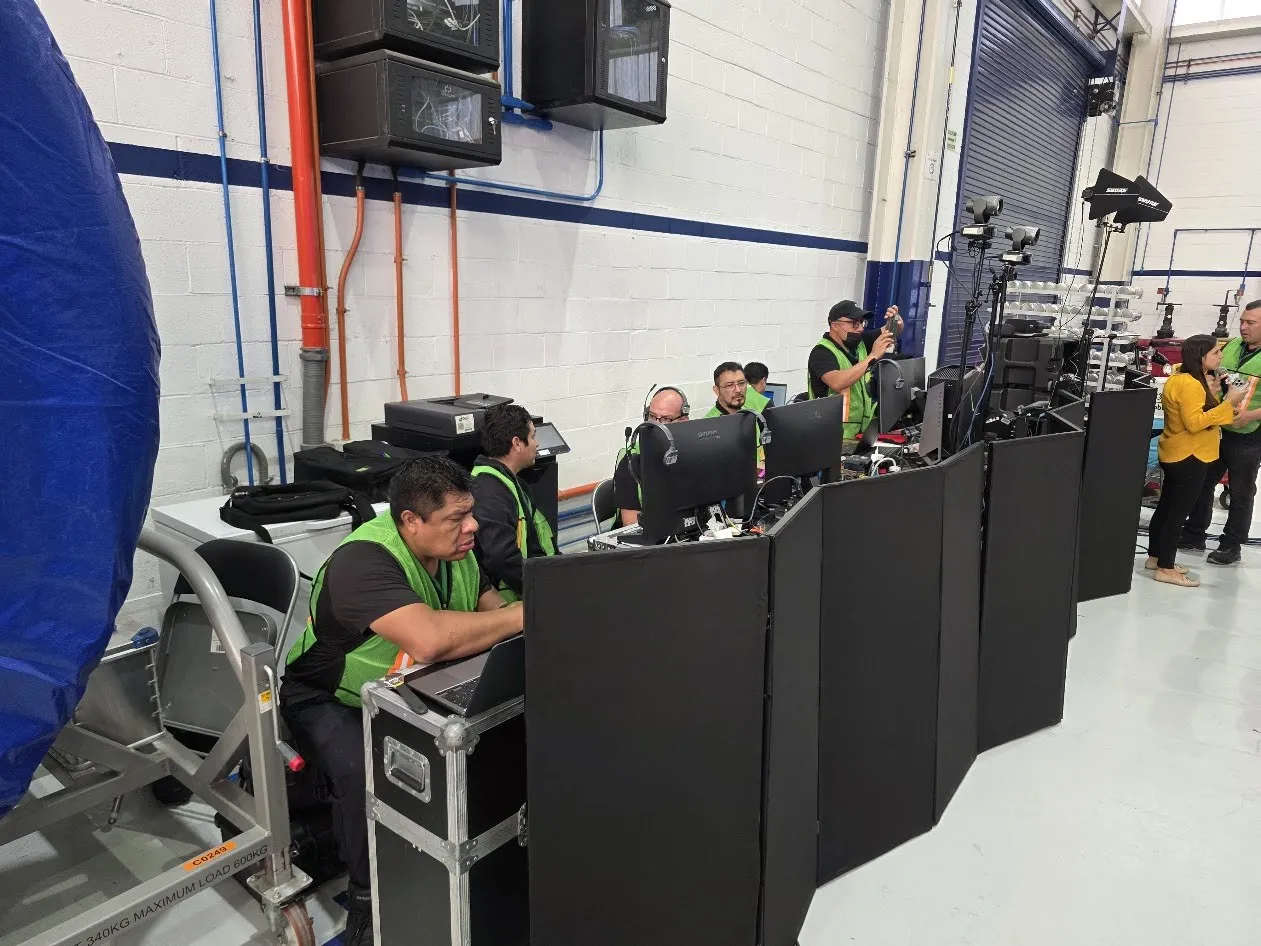
Production control area inside the ITP Aero plant in Querétaro, with crew in safety vests at the monitors.

ITP Aero · Querétaro, Mexico

ITP Aero All Hands 2026

A hybrid All Hands on an aerospace plant floor: 125 people in the room and more than 1,500 colleagues on Teams in four countries.

Turnkey production by Castelein AV for ITP Aero.

Further reading

Frequently asked questions

All questions

Can you connect multiple locations?

Yes. We connect rooms, floors, offices or cities into one program, either by producing each location or by building the local hub inside a wider workflow.

Multi-site work depends on clear rules: which location sends what, who directs, how timing is handled and how teams talk to each other during the show.

Also asked as: Can you connect several offices in one live broadcast? · Can two venues share one program?

Can sites in different countries join one broadcast?

Yes, depending on connectivity and the production at each site. Locations in other countries can receive the broadcast or contribute to it.

Time zones, local internet and who is responsible at each site shape the plan, so we map every location before we scope it.

Does all the equipment have to come from Mexico?

No. At sites outside Mexico, local equipment and crews can be combined with our production direction, where that makes sense.

We produce the Mexico locations with our own team and coordinate the standard, the connections and the run of show with the crews at the other sites.

Can you coordinate with teams in other time zones?

Yes. We regularly plan with teams in Europe and North America. We agree call times, a shared schedule and response expectations at the start of the project.

For live productions directed from another country, rehearsals and show calls are scheduled in both time zones so everyone works from the same timetable.

Also asked as: Can you work with a team in Europe? · How do you handle time differences with overseas producers?

What happens if connectivity fails?

What happens depends on the protections agreed for your event. With a backup connection or a bonded/cellular link, the stream can switch over; without one, the stream may drop while the local program and recording continue.

We agree the protections and the response plan in advance, including who informs the audience and what the room sees, so the team knows what to do if it happens. No connection can be guaranteed, and the proposal states what is and is not covered.

Also asked as: What if the internet goes down during our livestream? · Do you have a backup connection for streaming?

What internet connection does a livestream require?

A livestream needs a stable, preferably dedicated, wired upload connection with headroom above the stream’s bitrate. Stability matters more than the headline speed in the venue’s brochure.

The right figure depends on the number of streams, their quality and any remote speakers sharing the line. We test the actual connection at the venue and, when the risk justifies it, plan a second connection.

Also asked as: How much bandwidth do we need to livestream an event? · Is hotel Wi-Fi good enough for streaming?

Can you integrate with an international broadcast team?

Yes. We act as the local production team inside another producer’s broadcast: they design the architecture and direct the program; we build and run the local hub around their workflow.

For ICON’s global hybrid event, the Irish broadcast producer DV4 designed the global system and directed through its Zoom studio. Castelein AV, the team behind First Impact, built and operated the Mexico City hub and connected it into DV4’s setup.

Also asked as: Can you be the Mexico hub of our global broadcast? · Do you work as a local crew for overseas broadcasters?

Share your event brief

Tell us what you’re planning.

Share what you know so far: dates, city, venue, audience and what the production has to do. Unknowns are fine. We reply with questions or a scope-based proposal.